Monday’s “Buy the Dip” Miracle Lasted Exactly One Session – Tuesday Futures Pointing to Carnage Across Every Global Index
 Ahoy there, Trader! ⚓️
It’s Phil…
Remember Monday?
That glorious dead cat bounce where the S&P clawed back from -1.2% to close basically flat?
Where Bitcoin ripped from $63K back to nearly $70K? Where the talking heads on CNBC were falling over themselves to declare “markets are resilient” and “geopolitical crises are always buying opportunities”?
Yeah. About that.
The cat’s dead. Again. And this time it’s not bouncing.
Tuesday morning looks like a bloodbath across every global index on the planet. Europe is getting absolutely savaged. Asia got hammered overnight. And U.S. futures are pointing to an open that makes Monday’s initial sell-off look like a warm-up act.
I warned you on Saturday that there were three scenarios – and only one ended well.
We’re not in Scenario 1 anymore.
This isn’t a contained shock that markets are shaking off. This is an escalating, multi-day, multi-front conflict that’s now hitting data centres, embassies, oil refineries, LNG facilities, and commercial shipping.
And the market is finally pricing in duration.
Let me show you what happened overnight and why this changes the maths…
Keep scrolling – there’s a lot to unpack today…
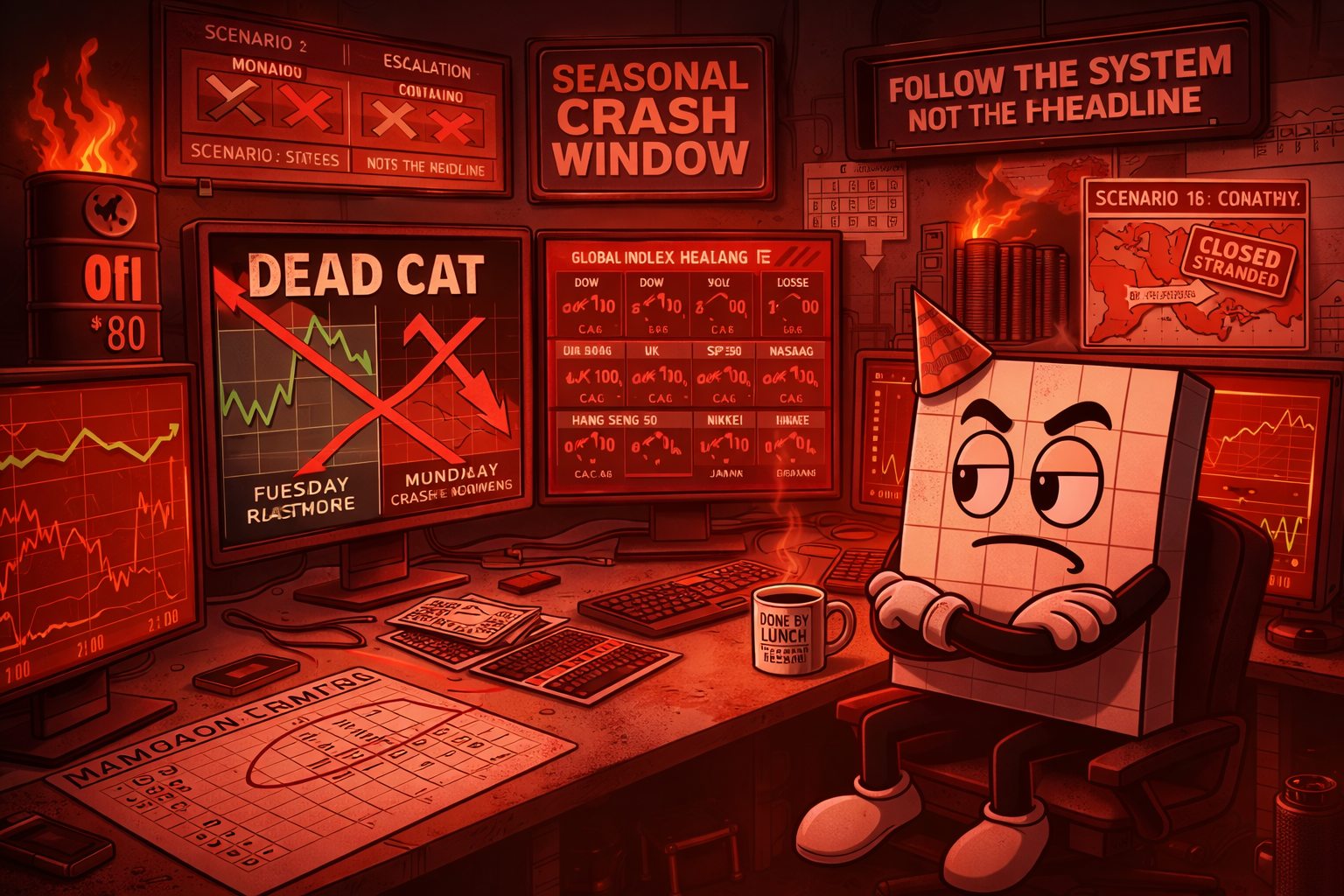
Dead Cat Bounce. Black Tuesday. Global Red Ink.
Market Briefing:
What Changed Overnight – The Escalation Nobody Wanted
Monday was a masterclass in wishful thinking.
Markets opened sharply lower, then staged a furious rally. The S&P 500 closed essentially flat. The Nasdaq even squeaked into the green. Defence stocks surged. Energy names ran.
Bitcoin bounced 10% off the weekend lows. Carson Group’s chief market strategist declared: “Historically, what in the near term seems like a geopolitical crisis tends to be largely resolved from a market perspective over the ensuing six months.”
Then the overnight news rolled in. And the “contained scenario” died.
Iran struck the U.S. Embassy in Riyadh with two drones, causing a fire and minor damage. When you’re hitting American diplomatic compounds in Saudi Arabia, we’ve left the “symbolic exchange” playbook far behind.
[Source: CNBC – “Stock market today: Live updates”]
Amazon’s AWS data centres in the UAE and Bahrain were physically struck by Iranian drones – the first time in history that a major U.S. tech company’s infrastructure has been hit by military action. Two facilities in the UAE were directly struck. A Bahrain facility was damaged by a nearby drone impact. Fires broke out. Sprinkler systems caused additional water damage. Cloud services across the Middle East went offline.
[Source: CNBC – “Amazon says drone strikes damaged 3 facilities in UAE and Bahrain”]
Think about what that means. Iran is no longer just targeting military installations. They’re hitting civilian energy infrastructure, diplomatic compounds, airports, hotels, and now the data centres that power the modern global economy.
QatarEnergy – one of the world’s largest LNG suppliers – shut down production indefinitely after Iranian attacks hit its Ras Laffan facilities. European natural gas prices surged by up to 34% on the news. That’s not a risk premium. That’s a real supply disruption with real inflation consequences.
[Source: CNN – “What we know about the widening US war with Iran on the conflict’s third day”]
And the IRGC commander doubled down on Monday: the Strait of Hormuz is closed, and any vessel attempting to pass “will be set ablaze.”
[Source: Al Jazeera – “Iran says will attack any ship trying to pass through Strait of Hormuz”]
At least five tankers have been damaged, two crew members killed, and approximately 150 ships are stranded around the strait. Maersk and Hapag-Lloyd have suspended all transits. Tanker traffic through the strait has dropped by roughly 70%.
The Numbers on Your Screen Right Now
Let’s talk about the chart your phone is showing you this morning. Because it’s all red. Everywhere.
Americas (Pre-Market):
- S&P 500 futures: 6,752 (-1.98%)
- Nasdaq 100 futures: 24,398 (-2.51%)
- Dow futures: 48,104 (-1.72%)
- S&P/TSX 60: -1.93%
Europe (Open):
- EURO STOXX 50: 5,756 (-4.02%)
- DAX: 23,636 (-4.29%)
- FTSE 100: 10,442 (-2.84%)
- CAC 40: 8,163 (-2.87%)
- IBEX 35: 17,116 (-4.33%)
- FTSE MIB: 44,385 (-4.18%)
Every single European sector is in the red. The STOXX Europe 600 is heading for its biggest two-day drop since April. Financials are leading the carnage: Banks -4.31%, Insurance -4.29%, Utilities -4.42%. The only sectors holding up relatively – and I use that word generously – are Oil & Gas (-1.71%) and Food & Beverage (-1.84%).
Asia/Pacific:
- Nikkei 225: 54,110 (-3.63%)
- KOSPI: Plunged 7.4% in catch-up trade after the long weekend
- Hang Seng: 25,396 (-1.01%)
- CSI 300: 4,644 (-1.43%)
- S&P/ASX 200: 8,890 (-1.59%)
Oil:
- WTI: $76.19 (+6.96%)
- Brent: $80.49 (+7.19%)
Bonds:
- European yields surging: German Bunds +9.5bps to 2.80%, French OATs +13.4bps to 3.42%, Italian BTPs +14.7bps to 3.49%
Bitcoin: Back down to roughly $66,300 after erasing Monday’s bounce to $70K.
Why Monday’s Bounce Was a Trap
This is worth understanding from a systematic perspective.
Monday’s rally was textbook dead cat bounce mechanics. The initial gap-down on Sunday night futures created panic selling. Then the buy-the-dip crowd piled in. Defence stocks like Northrop Grumman jumped 6%. Nvidia gained 3%. Energy names ran on higher oil. The S&P crawled back to flat.
Jeff Kilburg, CEO of KKM Financial, posted Sunday night that the market would turn green before Monday’s close. He was right. He called the dead cat perfectly.
But dead cats don’t bounce twice.
The problem with Monday’s “resilience” narrative was that it was built on a single assumption: this is a contained, short-term shock. The market was pricing Scenario 1 – strikes, counter-strikes, declarations of victory, then back to normal.
Tuesday’s price action is the market waking up to Scenario 2: sustained escalation with real economic consequences.
Consider what changed between Monday’s close and Tuesday’s open:
The U.S. Embassy in Riyadh was hit. Amazon’s data centres were physically destroyed by drones. QatarEnergy stopped producing LNG. European gas jumped 34%. Trump said operations could last weeks. The death toll in Iran reached 787.
Iran struck targets in at least seven different countries. An IRGC commander threatened to burn any ship in the Strait.
That’s not a headline the market “shakes off.” That’s a structural repricing of risk.
The Inflation Chain Reaction Is Now Live
This is the part that matters most for your portfolio over the coming weeks.
In Saturday’s article, I laid out the mechanical domino chain: Oil spikes → inflation returns → yields surge → liquidity tightens → risk assets get dumped.
That chain reaction is now active. In real time.
Oil has surged from roughly $67 (pre-strike) to $76+ on WTI and $80+ on Brent. That’s a 13-15% jump in four days.
European natural gas has exploded higher – up nearly 34% on Tuesday alone after QatarEnergy’s shutdown. Europe was already struggling with energy costs. This is petrol on the fire.
The ECB is suddenly in an impossible position. Euro-area CPI unexpectedly accelerated to 1.9% year-on-year in February – just below the 2% target. ECB board member Yannis Stournaras is urging caution. Chief Economist Philip Lane has warned a prolonged war could trigger an inflation spike.
A March Fed rate cut is now effectively off the table. ISM Manufacturing prices already jumped to 70.5 on Monday – screaming inflation. Higher oil on top of that? The Fed isn’t cutting anything. They might even be thinking about the opposite.
And when rate cut expectations evaporate, the liquidity that was propping up risk assets disappears with them.
Rabobank sees the Hormuz disruption lasting weeks to months. If that forecast is even close to correct, we’re not looking at a V-shaped recovery. We’re looking at a sustained repricing across every asset class that was built on cheap money and falling inflation expectations.
Wells Fargo’s Worst Case: S&P 500 at 6,000
Wells Fargo’s strategists mapped it out plainly on Monday: if we get a prolonged Hormuz closure and oil shocks above $100 per barrel, their model puts the S&P 500 at 6,000.
That’s roughly a 13% decline from Friday’s close of 6,879. From here, with futures already at 6,752, it would still represent another 11% of downside.
Their base case remains S&P 7,500 by year end. But that base case assumed contained geopolitical risk and falling inflation. Neither of those assumptions looks particularly healthy this morning.
Goldman Sachs’ Dominic Wilson made the key observation: the equity market’s reaction hinges not on headline risk but on the durability of the energy shock. Headlines come and go. Duration changes valuations.
Double Bounce or Fall Out the Apple Cart?
So here’s the question you’re all asking. After Monday’s dead cat bounce, does the market bounce again? Or do we fall out the apple cart entirely?
Here’s my systematic read:
The dead cat bounce pattern typically plays out in one of two ways. Either the market finds a higher low on the second test (which gives you a base to build from), or it breaks the initial panic low (which opens the trapdoor to significantly lower levels).
The key level to watch is Monday’s intraday low on the S&P – roughly 6,800 area. If Tuesday’s session can hold above that zone, there’s a chance the market consolidates and we get a tradeable range. If 6,800 breaks with conviction, the next support is the Wells Fargo bear case territory around 6,000-6,200.
For Bitcoin, the weekend low of $63,000 is the line in the sand. Monday’s bounce took us back to $70K. Tuesday has pulled us to $66,300. If $63K breaks, analysts see $60K as the next stop.
But here’s what I keep coming back to: this isn’t about predicting direction. This is about recognising what environment we’re in.
We’ve shifted from a low-volatility, range-bound market to a geopolitically-driven, headline-sensitive, elevated-VIX environment. The playbook changes. Position sizing tightens. Premium gets fatter. Patience becomes the primary edge.
What Systematic Traders Do on Black Tuesday
Premium Poppers: The opening range on a day like this will be massive. That means wider spreads, fatter premiums, but also more risk per trade. Stick to the system. Let the range establish itself. Don’t chase the first 15 minutes of chaos.
The VWAP retest entries still work – they just need more time to develop when volatility is this elevated.
Tag ’n Turn: The algorithms don’t care about geopolitics. They read price. If the bear breakout pattern goes active, you follow it. If we get a range reversal off support, you follow that. The 6 money making patterns work in war as well as they work in peace. That’s the whole point.
Lazy Poppers: Today might not be a lazy day. When the opening seesaw is this violent, the “lazy” setup needs the dust to settle properly. Be patient. Let the afternoon theta decay work for you rather than fighting the morning volatility.
Above all: do not let the headlines dictate your position sizing. The system was built for days exactly like this one.
The Bottom Line
Saturday I said: “Be prepared for multiple scenarios, not just the one you’re hoping for.”
Monday, the market hoped for Scenario 1. Tuesday, it’s waking up to Scenario 2.
The escalation is real. The Hormuz disruption is real. The inflation chain reaction is real. The repricing of rate cut expectations is real. And the carnage across every global index on your screen this morning is very, very real.
Does it get worse from here? Maybe. Does it bounce again? Possibly. Does it matter for systematic traders who follow their process?
Not one bit.
The range will tell us what to do. The setups will appear. The premium will be fat.
Follow the system. Not the headline.
Done by lunch. Even on Black Tuesday.
Expert Insights:
“The stock market is a device for transferring money from the impatient to the patient.” – Warren Buffett
On days like Black Tuesday, everyone’s an expert and nobody has a clue. The talking heads who called Monday’s bounce “proof of market resilience” are the same ones scrambling to explain Tuesday’s reversal.
Patience isn’t passive. Patience is the most aggressive thing you can do when everyone else is reacting emotionally.
The systematic trader doesn’t need to know whether Hormuz stays closed for a day or a month. They don’t need to predict whether oil hits $100 or retreats to $70. They need to know their levels, follow their setups, and manage their risk.
Events create volatility. Volatility creates premium. Premium creates income.
That’s the mechanical chain that works in your favour – but only if you stay disciplined enough to let it play out.
Rumour Has It…
From the Financial Nuts Newsdesk…
BREAKING: The Financial Nuts newsroom convened an emergency session at 4am Tuesday after Percy’s market alert system went off. The “system” turned out to be a pigeon that had flown into the office window, startled by the European market open. “That’s bearish confirmation,” Percy declared, presenting a chart that was not only upside down but appeared to be from 2019.
Hazel arrived looking like she hadn’t slept since Saturday – which, by all accounts, she hadn’t. Her desk was surrounded by a fortress of empty coffee cups, three Bloomberg terminals, and a whiteboard covered in equations connecting oil prices, LNG flows, European gas futures, and what appeared to be the takeaway menu from the curry house next door. “The natural gas move alone changes the entire ECB path,” she muttered, before adding: “I need a wine. It’s 6am but I’ve earned it.”
Wallie had been muttering about Black Tuesday since dawn. When someone pointed out this wasn’t quite the same as 1929, he snapped: “I shorted Enron. I know a real crash when I see one. Also, Amazon’s data centres are literally on fire. In my day we kept our data in filing cabinets. Filing cabinets don’t get hit by drones.” He had a point, though nobody wanted to admit it.
Kash rushed in clutching his phone, shouting about buying the Bitcoin dip at $70K on Monday. “Diamond hands, baby! This bounce is the real one!” He was then shown the current price of $66,300. A long pause followed. “The dip… has a dip,” he whispered, before retreating to his desk to delete his earlier tweets.
Mac arrived fashionably late in a three-piece suit, smelling of expensive cologne and whisky. “Darlings, the last time everyone panicked like this, I bought Rolls-Royce at the bottom. Wars are marvellous for aerospace.” He then raised a toast to defence stocks and started humming something from the 1920s.
Cache-AI-Bot ran a comprehensive analysis of all Financial Nuts predictions year-to-date and delivered the results: “Beep-Beep. Percy accuracy: 3.1%. Wallie accuracy: 41% (inflated by single Enron event). Hazel accuracy: 91.4%. Kash accuracy: statistically indistinguishable from a coin flip. Mac accuracy: irrelevant – he only buys things that pair well with whisky. Beep.”
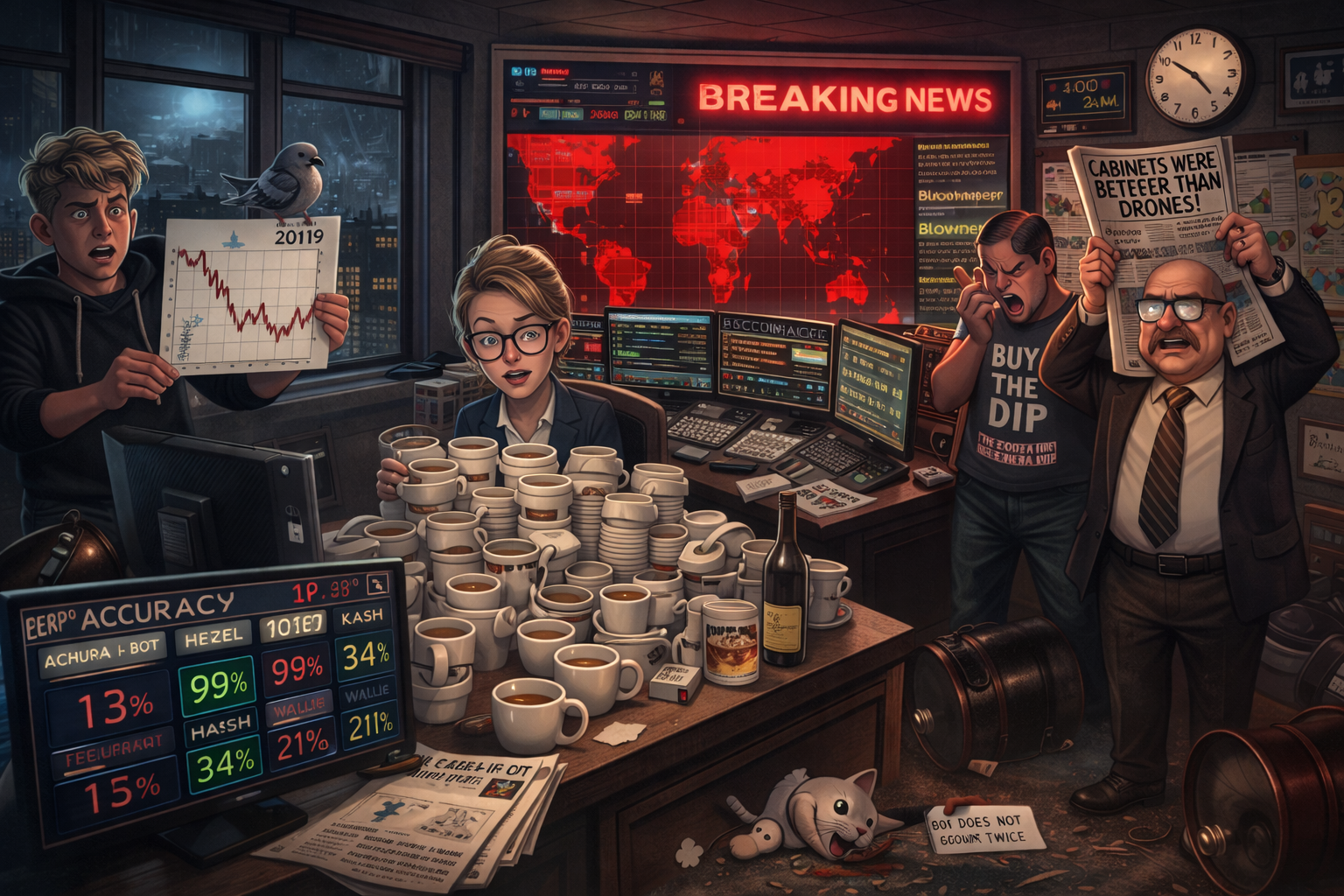
This is entirely made-up satire. Probably!
Breaking scoops courtesy of the Financial Nuts Newswire-because who needs sanity?

Fun Fact:
Happy trading,
Phil
Less Brain, More Gain
…and may your trades be smoother than a cashmere codpiece
p.s. There are 3 ways I can help you…
- Option 1: The SPX Income System Book (Just $12)
A complete guide to the system.
Written to be clear, concise, and immediately actionable.
>> Get the Book Here
- Option 2: Full Course + Software Access – 50% off for Regular Readers – Save $998.50
Includes the video walkthroughs, tools for TradeStation & TradingView, and everything I use daily. Plus 7 additional strategies
>> Get DIY Training & Software
- Option 3: Join the Fast Forward Mentorship – 50% off for Regular Readers – Save $3,000
>> Join the Fast Forward Mentorship – trade live, twice a week, with me and the crew. PLUS Monthly on-demand 1-2-1’s
No fluff. Just profits, pulse bars, and patterns that actually work.