The Realities of SPX Options Trading from the UK
 Ahoy there, Trader! ⚓️
It’s Phil…
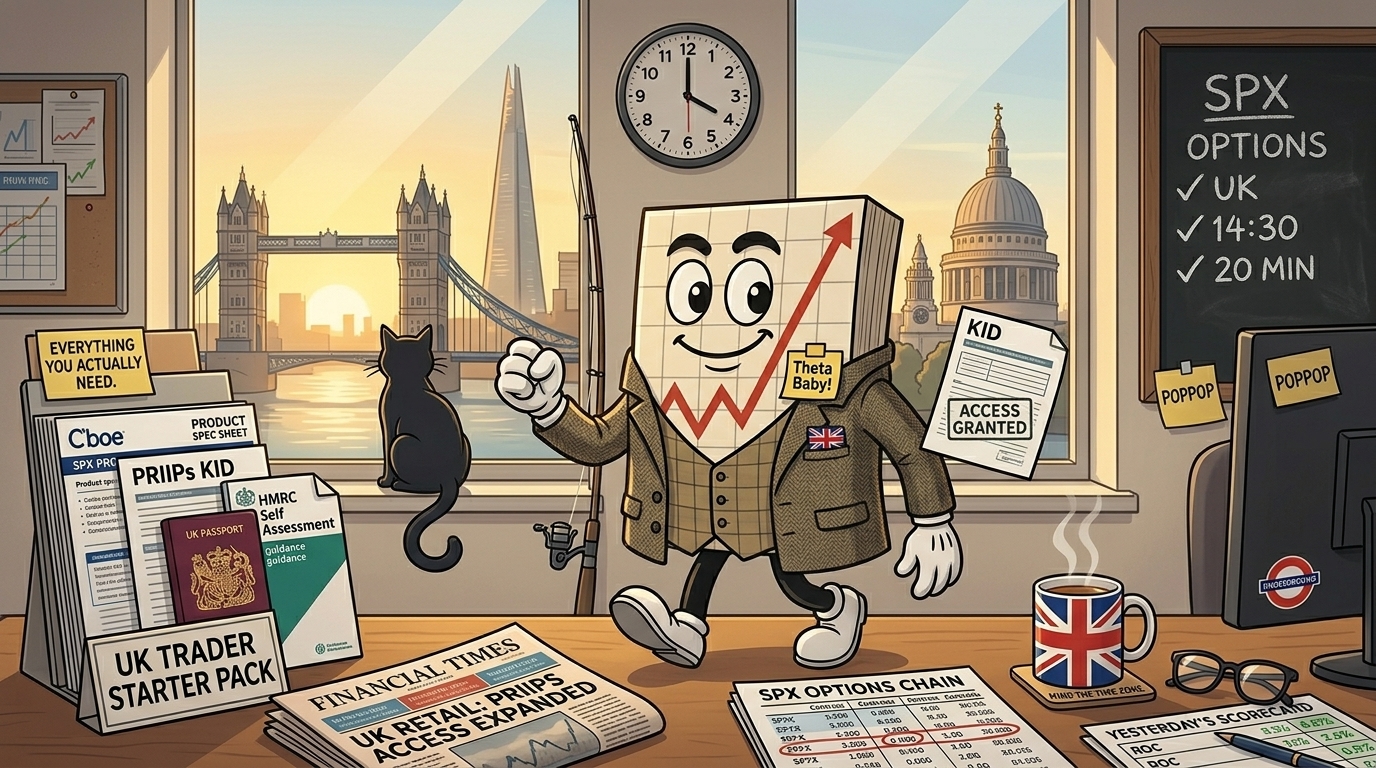
It is 14:30 on a Tuesday. The kettle has just gone on. Kids’ aren’t home from school yet, the dishes can wait, and across the Atlantic the opening bell rings on the largest equity market in the world. You spend twenty minutes at the kitchen table, place a defined-risk trade on the S&P 500, close the laptop, and get on with your evening.
That is the working reality of SPX options trading from the UK in 2026. Not staring at red and green numbers from breakfast to bedtime. Not running screens in three time zones. Twenty to thirty minutes of mechanical execution at a sensible hour, and the rest of the day is yours.
This guide covers the practical bits a UK retail trader actually needs to know: whether you can access these markets at all (yes), which brokers serve you, how HMRC treats the income, how the time difference works in your favour, and the strategy choices that suit a working professional rather than a screen-bound day trader. Written from a UK base, by someone who trades the instrument every day.
Table of Contents
- The Reality of SPX Options Trading from the UK
- Why UK Traders Are Choosing SPX Over FTSE 100 and DAX
- How to Access SPX Options as a UK Trader
- UK Tax Treatment: What HMRC Actually Wants
- Spread Betting vs Direct Options: The Real Trade-Off
- Trading Hours and Lifestyle Fit
- Strategy Foundations: What Actually Works
- Common Mistakes UK Traders Make
- Getting Started: A Practical Path
- Frequently Asked Questions
Get The Complete Premium Popper System – Automation Included
Your entry ticket to consistent SPX income. Inside: the exact setup, rules, and checklists I trade daily – for less than the cost of lunch. Easily actionable.
Get The Premium Popper System – Click Here
1. The Reality of SPX Options Trading from the UK
The first question most UK traders ask is whether they can even do this legally. The answer is yes, and it is more straightforward than the internet would have you believe.
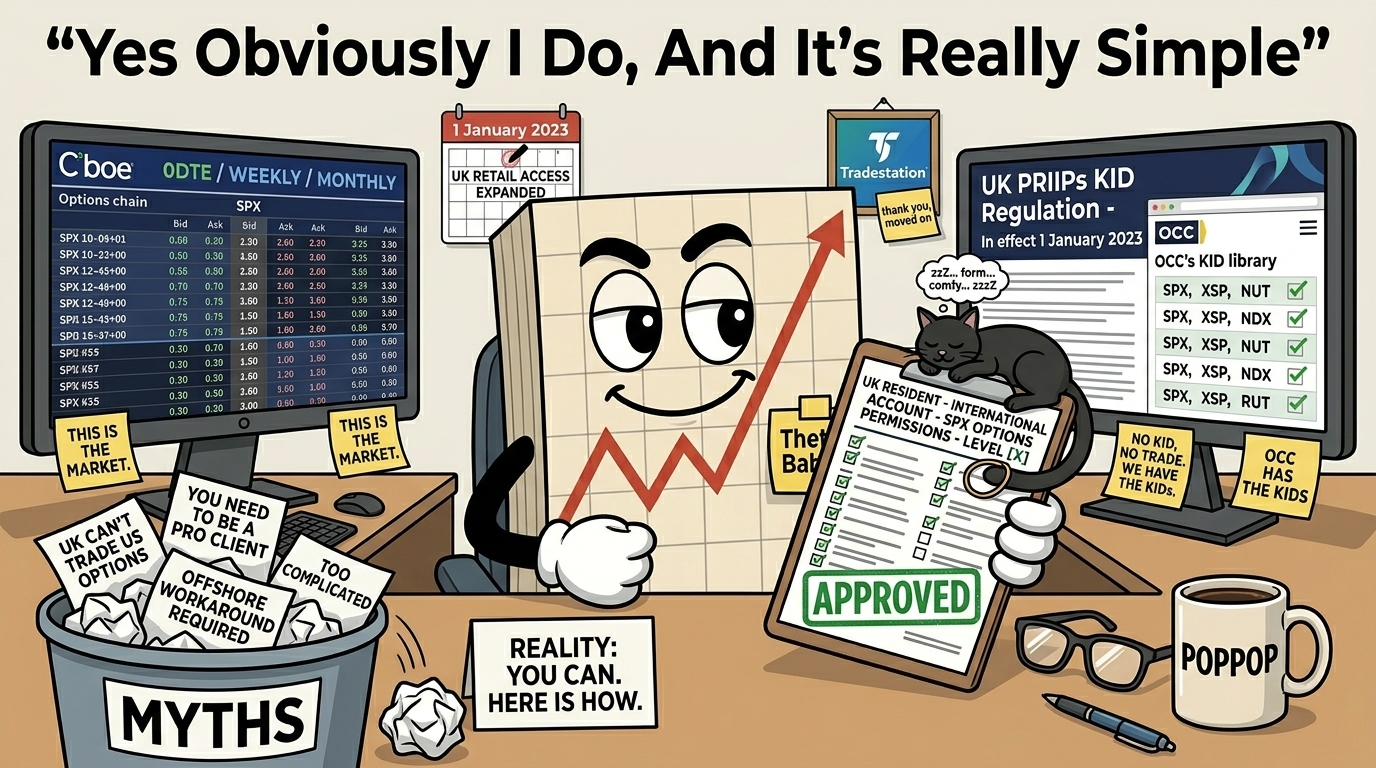
UK retail traders have direct access to SPX options through several US-domiciled brokers that accept UK residents, all of them either FCA-regulated in their UK arm or operating under disclosed international account structures. You open an account, you complete the suitability and options-permission steps, you fund it in dollars or your home currency, and you trade. There is no special licence required, no offshore workaround, no grey area.
The piece of regulatory furniture that confuses people is PRIIPs, the UK’s Packaged Retail and Insurance-based Investment Products Regulation. The rule is simple in principle: before a UK retail investor can be sold an in-scope product, the firm offering it must provide a Key Information Document, the KID, that explains the risks, costs and likely outcomes in a standardised format. No KID, no trade. That is genuinely the rule.
For SPX options the KID question is settled. The Options Clearing Corporation, which clears every listed US options trade, publishes KIDs for the products UK retail traders most often want, including SPX, XSP and the Nanos. Brokers display them at the point of order entry. The product is in scope, the documentation exists, and the trade goes through.
If you qualify under the FCA’s elective professional client criteria (broadly: portfolio above £500,000, demonstrable trading experience, relevant background), brokers will reclassify you. Professional clients sit outside retail PRIIPs and get a slightly cleaner experience. Most readers will be retail clients, and that is fine. Retail access is the point.
A piece of historical context that matters. Five years ago this article would have been shorter and more depressing. Pre-2022, UK retail access was patchy, KID coverage was incomplete, and several brokers turned UK residents away. The position has improved year by year. The market you can trade today did not exist for UK retail in this form a few years back.
So the legal piece is clean. The interesting questions are practical: which broker, what tax treatment, what strategy, what time of day.
2. Why UK Traders Are Choosing SPX Over FTSE 100 and DAX
If you are a UK trader looking for a serious options market, the FTSE 100 is not it. That is not a swipe at the index. The FTSE has its place. But the options market built on top of it is a fraction of the depth and activity of the SPX market, and for a systematic trader the difference is the difference between being able to do the job and not.
Liquidity. SPX is one of the most-traded options markets in the world. Bid-ask spreads on the front-month chains are tight, depth at every strike is real, and you can size positions properly without the price moving away from you. Try placing more than three to five lots on a typical futures contract and you will see slippage on every fill. SPX options swallow size that would visibly disturb other markets.
Daily expiries changed the game for income-focused traders. SPX now has daily expirations, including 0DTE for traders who want intraday risk windows. For premium-selling strategies that thrive on time decay, the optionality is enormous. You can construct positions that match your time horizon precisely, rather than being forced into weekly or monthly cycles built for someone else’s needs.
Cash settlement and European-style exercise matter more than they sound. SPX options settle in cash, which means you never wake up assigned shares you did not want. There is no early exercise risk. The position you opened is the position you close.
Position sizing scales cleanly. A few hundred dollars to a few thousand on a single trade fits inside the SPX liquidity profile without slippage and without screen babysitting. Compare that to trying to push size on most futures contracts, where you fight for fills above modest sizes.
Why this guide exists in 2026 and not 2019
Daily expiries. 0DTE access. UK retail platform parity with US clients. The way professionals trade SPX today simply was not available to UK retail five years ago. The instrument that this guide covers is, in important ways, a different product to the one your older relative might have looked at and given up on.
The combination is what matters. There is no other market where deep liquidity, daily expiries, cash settlement, scalable position sizing, and no early exercise risk all exist together at retail scale.
3. How to Access SPX Options as a UK Trader
Four brokers serve UK retail clients and offer SPX options at meaningful quality. None of them is wrong. The right choice depends on what kind of trader you are.
This section is education, not endorsement. Detailed broker comparisons live in the supporting article in this cluster. Here, the honest read.
Tastytrade
Built for options traders. Not stock traders with options bolted on. Options traders. The order ticket assumes multi-leg trades, the analytics centre on probability and theta, and the commission schedule rewards opening trades and closes for free.
UK access is via the international account route. Application is straightforward (passport, proof of address, suitability questions), funding by wire, and the platform looks identical to the US. UK clients sit under the US entity for clearing and protection: SIPC investor protection up to $500,000 ($250,000 cash sub-limit).
If your trading is options-led and your strategies involve spreads, butterflies, iron condors and similar defined-risk structures, tastytrade’s workflow is a serious advantage.
Tradestation
The slightly older, slightly more powerful cousin. Native charting that has been an institutional gold standard for decades, deep order management, full futures integration, and a research-driven approach to strategy development.
UK access runs through TradeStation International Ltd, FCA-authorised as introducing broker. The trading account itself sits with Tradestation Securities in the US under SIPC protection. Account opening involves slightly more paperwork than the others. Non-US clients pay $5 per equity trade rather than the US $0 rate, which matters more for stock traders than options-focused ones.
If you want one platform that handles automated strategy backtesting through to order routing, Tradestation rewards the time you put into learning it.
Interactive Brokers
The global heavyweight. UK clients open accounts with Interactive Brokers (UK) Limited, FCA-regulated under reference 208159. Proper UK entity, proper UK regulatory protection.
The reasons to choose IBKR are scale and breadth. Stocks, ETFs, options, futures, futures options, forex, fixed income, direct exchange routing on more international venues than you will ever need. Index options like SPX, NDX and RUT require separate enabling, which protects newer traders but does mean a brief approval step.
IBKR also offers ISA and SIPP wrappers via its UK affiliate, useful for traders who want some of their account inside tax-advantaged structures. The trade-off is Trader Workstation’s learning curve. The newer IBKR Desktop and web interfaces have softened that, but the platform is not one you master in an afternoon.
For traders who want one account to handle everything, including the FCA-regulated UK relationship, IBKR is the obvious choice.
Schwab (with thinkorswim)
Charles Schwab acquired TD Ameritrade in 2020 and integrated thinkorswim, the platform many traders consider the strongest analytical toolkit in retail. In June 2024 Schwab launched direct UK access under Schwab Trading Powered by Ameritrade. Pre-2024 this was not possible at retail scale.
UK access is FCA-authorised, options pricing is $0.65 per contract, no minimum to open. The thinkorswim suite includes desktop, web and mobile, with paperMoney built in. For traders wanting the depth of options analytics thinkorswim is famous for, the recent UK opening is a significant upgrade in choice.
A note on charting
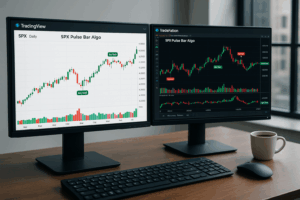
For twenty years I traded on Tradestation’s native charts. About five years ago I moved to TradingView, and I have not looked back. TradingView is broker-agnostic, runs in any browser, and the chart engine is faster and cleaner than anything I had used previously.
This matters because the charting decision is separate from the broker decision. You do not need brilliant broker charts if you are using TradingView. That frees you to choose a broker on order quality, fee structure, and protection.
Broker landscapes move. Verify current details before opening an account. The supporting “Best Brokers” article in this cluster goes deeper.
4. UK Tax Treatment: What HMRC Actually Wants
Tax is the question that derails more would-be UK options traders than any other. The good news is that the rules are clearer than the internet suggests. The less good news is that the recent direction of travel has not been kind to active investors.
This section is current for the 2026/27 UK tax year. None of it is personal advice. Use it as orientation, then talk to a qualified UK tax adviser.
The default position: Capital Gains Tax
For the overwhelming majority of UK retail options traders, profits and losses on SPX options are treated as capital gains and losses. Not a quirk or a workaround. UK tax legislation explicitly charges gains arising from “dealing in certain commodity or financial futures, traded options or financial options” as capital gains.
You hold an account, you place trades, you close them in profit or loss, and at year end you sum the realised position. Gains above your annual exempt amount are taxed at the prevailing CGT rate. Losses can be set against gains in the same year and carried forward indefinitely, provided you report them.
The 2026/27 numbers
The figures you actually need:
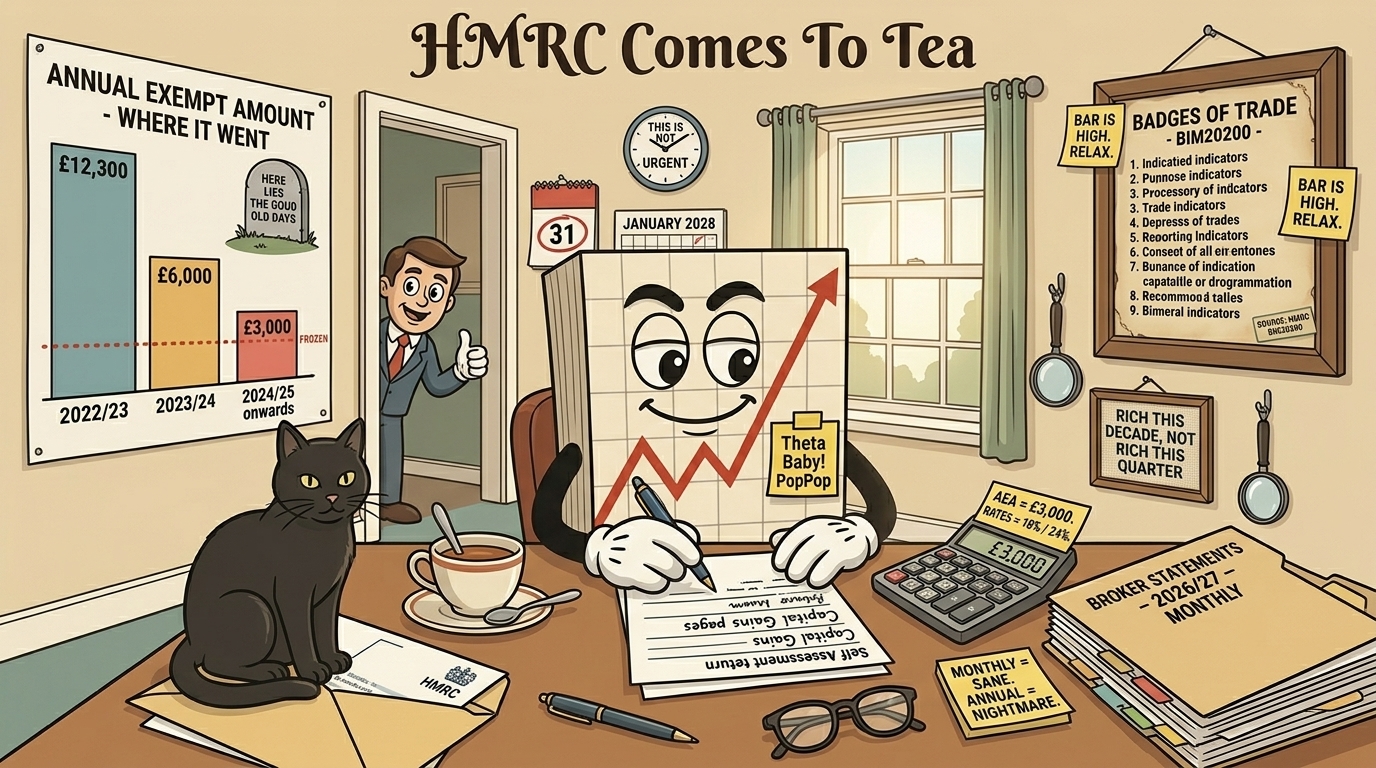
- Annual exempt amount (AEA): £3,000 per individual. This is the amount of net capital gains you can realise tax-free in a tax year. The AEA cannot be carried forward. Use it or lose it.
- CGT rate, basic-rate taxpayer: 18% on gains above the AEA
- CGT rate, higher and additional-rate taxpayer: 24% on gains above the AEA
- Reporting: Self Assessment, return filed and tax paid by 31 January following the end of the tax year (so 2026/27 gains report by 31 January 2028)
- Mandatory reporting threshold: You must report capital gains to HMRC if either your gains exceed the AEA, or your total disposal proceeds in the year exceed £50,000, even when net gains are below the AEA
A historical note for context. The AEA was £12,300 in 2022/23, cut to £6,000 in 2023/24, cut again to £3,000 from 2024/25 and held there since. The shelter retail investors used to enjoy has been reduced by roughly three quarters in three years. For active traders, this means tax planning is no longer optional, and using ISA and SIPP wrappers (where eligible) matters more than it used to.
When HMRC might say you are a “trader” for tax purposes
In rare cases, HMRC may take the view that your activity is a trade carried on as a business. If that argument succeeds, profits become trading income, taxed at income tax rates and subject to National Insurance, with full deduction of business expenses in compensation.
This is unusual for retail options traders. HMRC’s general position, reflected in their Capital Gains Manual and Business Income Manual, is that derivatives trading by individuals is normally taxed as capital gains. The trading-income outcome is the exception.
The framework HMRC uses is the badges of trade (Business Income Manual reference BIM20200): profit-seeking motive, frequency of transactions, length of ownership, subject matter, supplementary work, method of acquisition, method of disposal, source of finance, and existence of similar transactions. No single badge is conclusive; HMRC and the courts assess the overall picture.
A retail trader placing a few defined-risk trades a week from a kitchen table, holding a separate day job, and using their own savings, is overwhelmingly likely to be treated as an investor. A full-time trader running a substantial book, treating it as primary income, with sophisticated infrastructure, is more likely to attract trading-income treatment. If you are uncertain, talk to a UK accountant who handles active trader cases.
Practical reporting
- Self Assessment Capital Gains pages: the standard route. Your broker provides a year-end statement showing realised gains and losses, and you translate this into the tax return.
- HMRC’s Real Time Capital Gains service: allows you to report and pay during the tax year, useful for keeping on top of liabilities rather than discovering them in January.
- Trading allowance: £1,000 of miscellaneous income before reporting is required. Limited use in the options context but worth knowing about.
Keep transaction records as you go. Reconstructing them five years later when an HMRC enquiry lands is more friction than a clean monthly folder.
A reminder on the obvious
Tax law changes. The figures above are current for 2026/27. When you read this in eighteen months, verify the live numbers on GOV.UK. The framework is structurally stable. The numbers attached to it are not.
5. Spread Betting vs Direct Options: The Real Trade-Off
If you have spent any time in UK trading communities, someone will have told you that spread betting is “tax-free” and therefore the obvious choice. The first half is true. The second half misses the point.
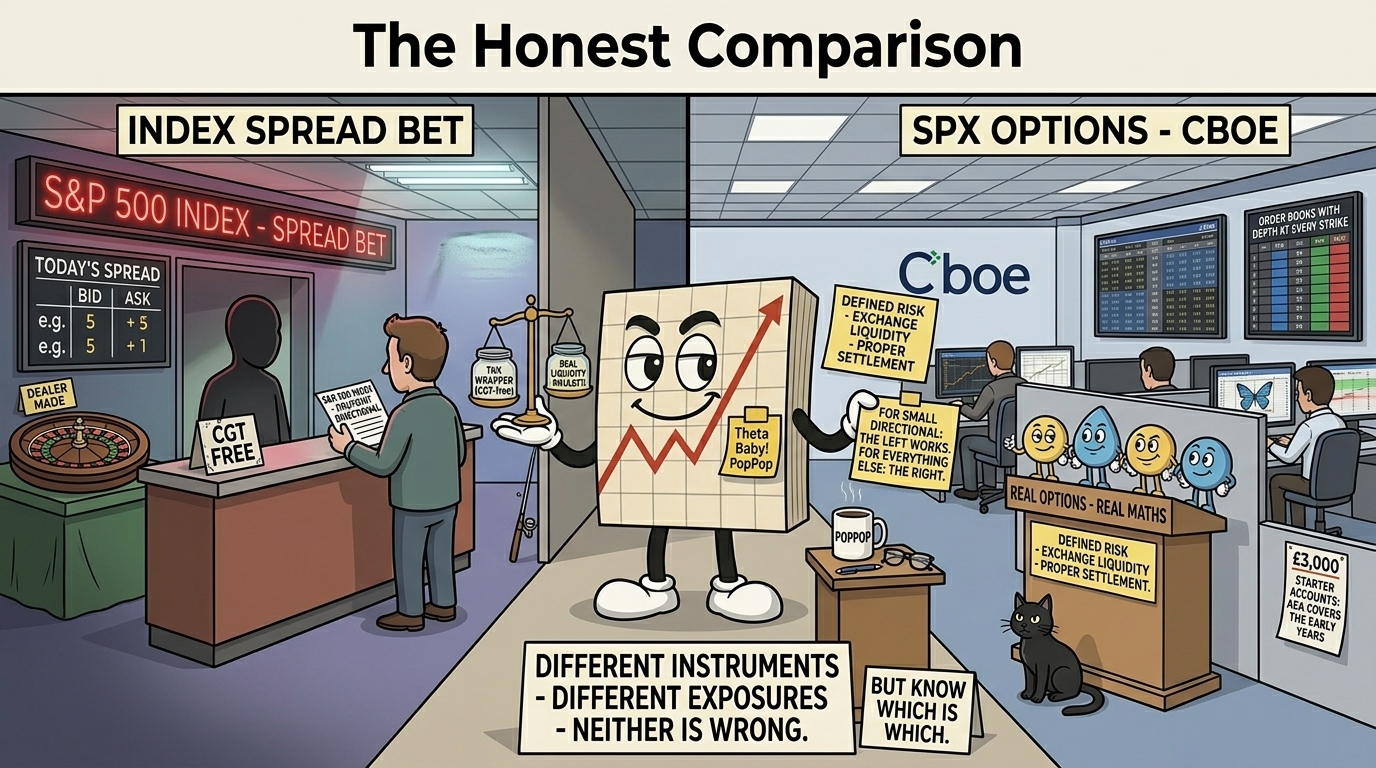
Worth being clear on what is being compared. UK retail spread betting firms (IG, CMC Markets, Spreadex and others) quote spread bets on the underlying index (the S&P 500 cash market or the S&P 500 futures), not on US-listed SPX options as such. Spread betting on US-listed options at retail is rare and dealer-made when it exists at all. So the genuine comparison is between two different exposures:
- Spread betting the S&P 500 index, CGT-free wrapper, dealer-made market, position behaves like a directional bet on the cash or futures price
- Trading SPX options on Cboe, taxable under CGT (per Section 4), real exchange liquidity, defined-risk strategies available, position behaves like an options trade with theta, delta, gamma and vega
Different instruments giving different exposures.
The case for spread betting
For very small accounts, occasional directional bets, or traders who genuinely want directional exposure to the index without the operational mechanics of an options chain, spread betting is a perfectly reasonable choice. The CGT-free wrapper is real. For anyone trading inside the current £3,000 annual allowance, the practical tax saving is modest, but on larger directional positions the wrapper compounds.
The case for direct options
For systematic traders, the case is structural rather than emotional:
- Real exchange liquidity. SPX options trade on Cboe with depth at every strike. The bids and offers you see are the market. Spread betting markets on US-listed options, where they exist, are dealer-made, which means the firm is your counterparty and the price is whatever they show.
- Defined-risk structures. Spreads, butterflies, iron condors, calendar spreads work cleanly on listed options because each leg is a real contract with a real price. Recreating these inside a spread betting wrapper is either impossible or costly.
- Theta, vega and the rest. Premium-selling strategies depend on the precise behaviour of the Greeks. Listed options give you the mathematics. Spread betting gives you a directional payoff with the Greeks abstracted away.
- Slippage at scale. The spread cost on retail spread betting becomes meaningful as size grows. Above modest position sizes, the implied cost eats the tax advantage.
Where the line falls
For directional, occasional, small-sized exposure: spread betting probably wins on simplicity and tax. For systematic income strategies, defined-risk structures, or any approach that treats options as options rather than directional proxies: listed SPX options on Cboe is the obvious answer, and the tax cost is the price of access to a proper market.
The current £3,000 annual CGT allowance is not nothing. For a starter account, the allowance covers your early profitable years before you owe any tax. By the time you are scaling beyond that, the slippage and structure issues with spread betting on serious size matter more than the CGT bill.
[INFOGRAPHIC: Side-by-side comparison: Spread betting the S&P 500 index vs trading SPX options on Cboe. Columns: Tax wrapper, Counterparty, Liquidity source, Strategy structures available, Greeks visibility, Best for. Production designs for clean visual scannability.]
6. Trading Hours and Lifestyle Fit
This is the section that sells the lifestyle angle. It is also the section that converts the time-difference “problem” into an active feature.
The mechanics first. The UK is normally five hours ahead of New York. That makes the standard US equity market open of 9:30 a.m. ET equal to 14:30 UK time. The close is at 21:00 UK time. There are two short windows each year (typically about three weeks in March, around one week at the end of October) when the daylight saving switches don’t line up between the US and UK, during which the difference shifts to four hours and the open lands at 13:30 UK.
For a UK-based working professional, this is genuinely better than a UK-equivalent market would be.
Why 14:30 is the perfect open
Mornings are yours. Whatever you do in the morning, the US market does not open until your afternoon. Coffee, kids, work, exercise, meetings: the morning runs the way it needs to. The market is not screaming at you while you are doing something else.
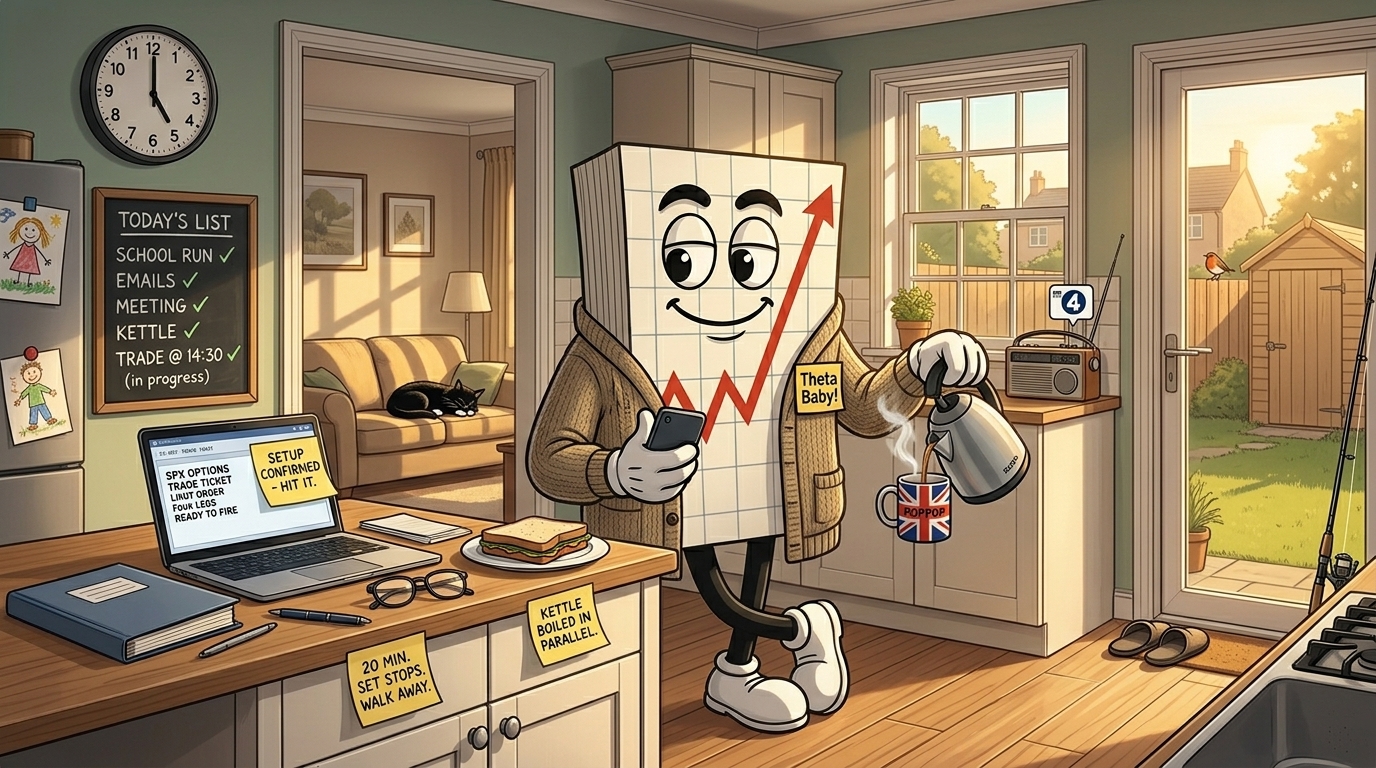
Lunch is the natural transition. By 14:30 you are wrapping up whatever you were doing, the kettle goes on, and you sit down to look at the chart. Twenty to thirty minutes later, the trade is on, the order is filled, your stops are set, and you walk away.
“Twenty to thirty minutes regardless of your experience level is all that is needed.”
That figure refers to the daily execution window: time required to assess setups, place trades, set stops, walk away. It is not a claim about how much money you will make in twenty minutes. The amount of capital your account generates is a function of strategy, position sizing, market conditions and time. The twenty to thirty minutes is the time you spend in the chair to put the work in.
Tea-time check, evening reclaimed
For swing trades held overnight or across multiple days, the workflow simplifies further. A check at tea time. Are positions still inside the trade plan? Yes? Carry on with the evening. No? Adjust or close, then carry on. The market closes at 21:00 UK, by which point most of the day’s volatility has played out.
The contrast with what most professionals imagine trading looks like is the point. The “screen all day” model that puts most working people off trading is genuinely not the model that works for systematic SPX options. The best edge for premium-selling strategies is not staring at every tick. It is rules, mechanical execution, and patience for conditions to develop.
[LIFESTYLE IMAGE: UK kitchen at 14:30. Phone on the counter showing a trade alert. Kettle. Late afternoon light starting to spread across the worktop. Sells the lifestyle angle visually without being staged or corny.]
7. Strategy Foundations: What Actually Works
Strategy is where this article turns from explanation into a point of view. Two beliefs underpin the systematic approach to SPX options that I trade and teach.
The first belief is that the market rewards discipline, not excitement. Most traders blow up because they trade emotionally, override their rules, and treat the market like a casino with better lighting. Mechanical, rules-based systems are unglamorous, and unglamorous is precisely the point. The boring traders are the ones who survive the next decade.
The second belief is that systems should be built for the life you actually live, not for the life of a Wall Street prop trader. This bit matters, because it is the reason the framework I use looks the way it does.
Why this system exists
I built this system because I had to. I have Crohn’s disease, which means I have stretches when I am not at my best and physically cannot sit at a screen for hours. I needed a way to check in, check for a setup, place a trade if conditions were right, and check out. Everything else had to wait or run without me. That constraint forced the entire architecture: rules-based entries, mechanical management, mobile execution, software that does the pattern recognition so I do not have to.
That constraint is mine. The framework that came out of it happens to suit anyone whose life does not revolve around being available to the market all day. Working professionals, parents, anyone with health considerations, anyone with anything else going on. The logic is the same. If your trading depends on being chained to a screen, your trading depends on something fragile.
Rules-based vs discretionary
A rules-based system specifies in advance what counts as a setup, what counts as an entry, what counts as a stop, and what counts as an exit. The trader’s job is to recognise conditions and execute. A discretionary system relies on judgement at each step. Discretionary trading can work, but it is exhausting, inconsistent, and requires years of screen time to develop the pattern recognition that the rules give you on day one.
For working professionals, rules-based wins on three counts. Time-efficient because you do not need to be present for the analysis, only the execution. Emotionally consistent because the rules do not panic when the market moves against you. And scalable because the same rules work whether you are trading two contracts or twenty.
Software that does the heavy lifting
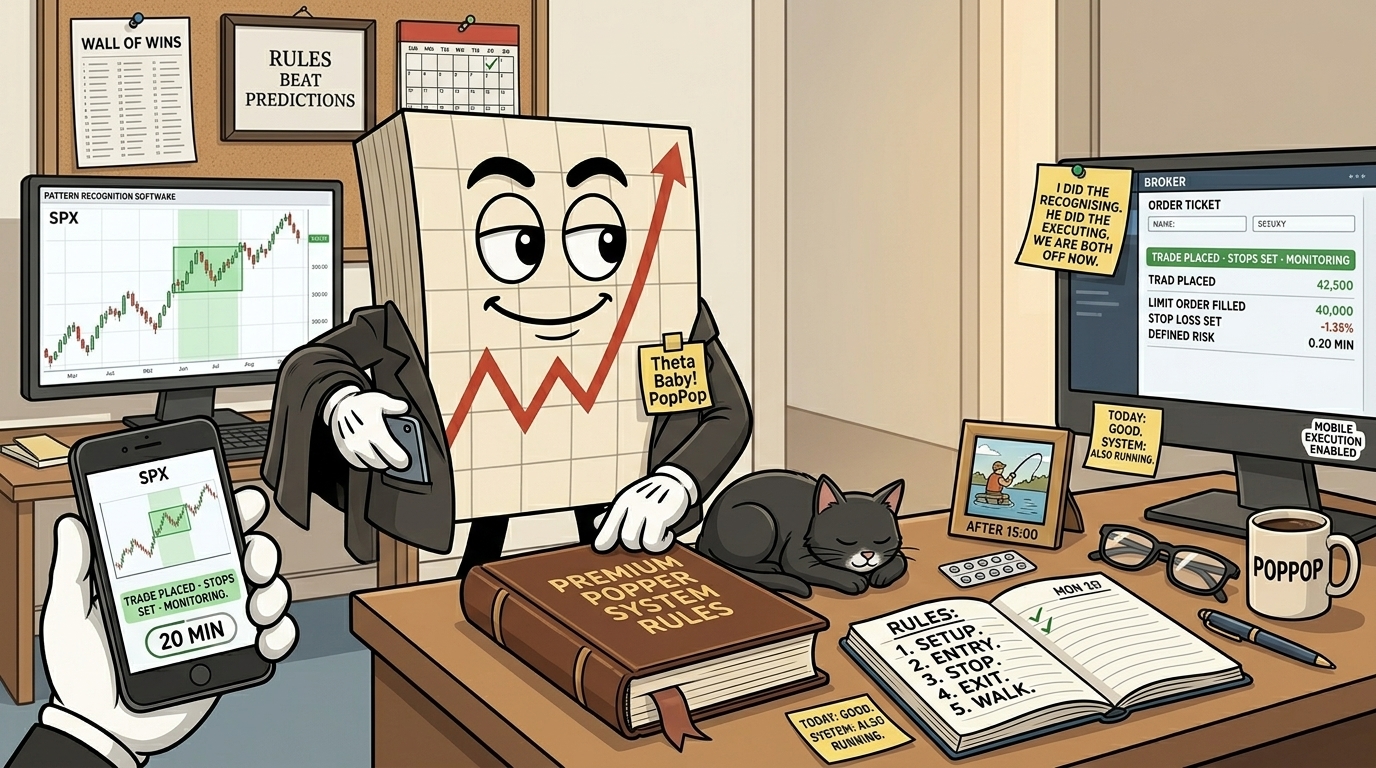
The trader’s edge in 2026 is not faster eyes. It is software that flags conditions and waits patiently while the trader gets on with their day. My setup uses chart-based pattern recognition that highlights setups directly on the chart. When conditions trigger, the system alerts me. I open the broker app, place the trade, set the stop, close the app. The software watches. I execute.
The honest note on the learning curve
While you are learning a system, expect to take longer than the twenty to thirty minutes. You will check the rules twice. You will second-guess the entry. This is normal and intended. The rules become automatic over weeks, not days. Many of my students reach competent execution within a couple of weeks. Mastery is a longer arc, but you do not need mastery to start trading profitably. You need rules, discipline, and the willingness to follow them.
Where to go from here
If you want a structured entry into systematic SPX trading, the Premium Popper System is the daily-execution framework I teach to traders who want a clean, rules-based premium-selling setup. The SPX Income System is the broader framework, covering swing-trading approaches and longer-horizon premium strategies. Live Training and Mentorships are available for traders who want guided implementation. Links at the end of this guide.
8. Common Mistakes UK Traders Make
A short version of the wisdom you would otherwise pay for over five lost trades.
Treating options like lottery tickets. Buying long calls, hoping the underlying rips, and watching the position decay to zero. Long premium can work in specific conditions but it is not a default strategy. New traders default to it because the loss is “limited” and the upside looks unlimited, then wonder why the account bleeds out.
Undefined risk on the wrong side of expiry. Selling naked options without a defined-risk structure to cap the downside. If a single bad trade can take 30% of the account, the trade is sized wrong, structured wrong, or both.
Position sizing errors. Putting on size the account cannot absorb on a normal loss. The trade that blows you up is not the bad setup. It is the one you put on too big, before you had earned the size, because you saw a “perfect setup” and got greedy. Size to the loss, not to the win.
Choosing brokers on cost alone. A platform that costs you a dollar more per trade and saves you a missed fill is the cheaper platform. Commission per contract matters; it does not matter as much as fill quality, platform reliability, and operational flow.
Ignoring tax reporting from day one. UK traders who do not keep records discover in January that they need to reconstruct the year from scratch. This costs more in accountant fees than the actual tax. Keep clean records monthly. Ten minutes.
Skipping paper trading because of impatience. Every broker offers a simulator. Use it. Two weeks of paper trading before live capital saves more than two weeks of expensive lessons.
Following social media gurus who post wins and never losses. Anyone showing only wins is selectively posting. Real traders lose roughly 30 to 40 percent of trades on a typical premium-selling strategy. The arithmetic still works because winners cover losers. A trader who posts only wins is showing you marketing, not trading.
Trying to predict direction instead of trading the rules. Predictions are interesting at dinner parties. They are expensive in trading accounts. Systematic options strategies do not require directional accuracy. They require disciplined execution of probability-based setups. Stop predicting. Start executing.
The common thread is patience and process. Markets reward boring, disciplined behaviour over thrilling, conviction-led behaviour. If your trading feels like a thriller film, you are doing it wrong.
9. Getting Started: A Practical Path
The simple sequence:
1. Open an account. Pick one of the four brokers in Section 3. If you are not sure, IBKR is the most flexible default. If you are options-focused from day one, tastytrade is the obvious entry.
2. Set up your charting. TradingView for analysis, broker platform for execution. A free TradingView account covers most retail use cases.
3. Learn a rules-based system. This is where structured education saves months of trial and error. Whether through Antivestor or elsewhere, internalise the entry, management and exit rules of a single system before adding complexity.
4. Paper trade for two to four weeks. Run the system on simulated capital. Verify that you can recognise setups, place orders correctly, and follow the rules under simulated stress.
5. Trade live, small. Start with size that is small enough that a normal loss is a non-event. Two contracts, one contract, however small you need to go. Going live adds the emotional dimension to the rules. Size up only when execution is clean.
6. Scale slowly. Add size as the system delivers consistent results across enough trades to mean something. Twenty trades is not enough. Fifty starts to be meaningful. A hundred is where you can start trusting the data.
The realistic timeline. Most students of the system place live trades within a few days of starting. Profitable consistency takes longer, depending on individual learning speed, but the framework is straightforward. The barrier is not complexity. The barrier is patience and discipline.
For smaller accounts that want to trade more actively, the Pattern Day Trader rule changes are worth understanding. The full breakdown is in the PDT Rules article, which walks through margin treatment for accounts under $25,000 and the legitimate paths to running short-horizon strategies on smaller balances.
For social proof that the system works for ordinary working people, not just full-time traders, the Wall of Wins page collects the trades and notes that students send in each week.
10. Frequently Asked Questions
1 – Is it legal for UK residents to trade SPX options?
Yes. UK retail traders can open accounts with several US-domiciled or UK-FCA-regulated brokers and trade SPX, XSP and Nanos directly. The product falls inside the UK PRIIPs framework, the Options Clearing Corporation provides the required Key Information Documents, and brokers display them at order entry. There is no special permission, professional licence, or workaround required.
2 – Do I need to be classified as a professional trader to access SPX options?
No. SPX options are accessible to UK retail clients through the brokers in Section 3. Some traders qualify for elective professional client status under FCA criteria, with Interactive Brokers UK the most common route. Professional status is not a requirement.
3 – What is the minimum account size to start trading SPX options from the UK?
All four brokers in Section 3 have a $0 account minimum. The practical minimum is higher because the standard SPX contract has a $100 multiplier, so defined-risk spreads need a few thousand dollars of margin. The XSP (Mini-SPX) contract is one-tenth the size and brings the practical minimum down considerably. Start with what you can afford to lose, sized for the contract you are trading.
4 – How are SPX options gains taxed in the UK?
For most UK retail traders, profits and losses are taxed as capital gains. The 2026/27 annual exempt amount is £3,000, with rates of 18% for basic-rate taxpayers and 24% for higher and additional-rate taxpayers on gains above the AEA. Reporting is via Self Assessment by 31 January following the tax year. In rare cases HMRC treats very high-frequency, large-scale trading as a trade, which makes profits subject to income tax and National Insurance. See Section 4 and consult a UK tax adviser.
5 – Is spread betting on US indices the same as trading SPX options?
No. UK retail spread betting firms quote on the underlying S&P 500 index (cash or futures), not on US-listed SPX options. Spread bets are dealer-made products providing directional exposure within the CGT-free spread betting wrapper. SPX options on Cboe are exchange-traded contracts with real liquidity, defined-risk strategies, and CGT treatment. Different instruments. Section 5 covers the trade-off.
6 – Can I trade SPX options inside a SIPP or ISA?
Stocks and Shares ISA rules generally do not permit retail trading of US-listed options. SIPPs are more flexible and some providers (Interactive Brokers UK among them) permit options trading inside the wrapper, subject to suitability and internal permission. Check with your provider. Wrappers that allow it remove the CGT consideration on gains made inside.
7 – What time do US markets open in UK time?
The standard US open of 9:30 a.m. Eastern Time is 14:30 UK time for most of the year. During roughly three weeks in March and around one week in late October, the daylight saving transitions are out of sync and the open shifts to 13:30 UK. The market closes at 21:00 UK (20:00 during the offset windows).
8 – Do I need to be at my desk all day to trade SPX options?
No. Systematic, rules-based SPX options trading typically requires twenty to thirty minutes of daily execution time, with optional pre-market preparation and an evening check on swing trades. Software handles pattern recognition; the trader handles execution. Section 6 covers the workflow.
9 – Which broker is best for UK SPX options traders?
There is no single answer. The right choice depends on whether you are options-focused (Tastytrade), want maximum platform breadth (Interactive Brokers), prefer institutional-grade desktop charting (Tradestation), or want thinkorswim’s analytical depth (Schwab). The supporting “Best Brokers” article goes deeper.
10 – How should I think about position sizing for a starter UK SPX options account?
Size to the loss, not to the win. The defined risk on a typical premium-selling spread should sit somewhere between 1% and 3% of total account capital. For a starter account, lower is better while you build the execution muscle. The XSP contract (one-tenth the size of SPX) is the practical entry point where standard SPX contracts would put too much capital at risk on a single trade. The principle is the same regardless of account size: a normal loss should be a non-event for the account, not a portfolio-resetting event.
About the Author
 Phil Newton is the founder of Antivestor, a systematic options trading education platform specialising in SPX and RUT strategies. UK-based, with thirty-three years in markets, Phil teaches a process-driven approach to options income, mechanical execution, and the systematic frameworks that suit working professionals rather than full-time screen-watchers.
His daily market analysis and student trade highlights are published at antivestor.com and mrphilnewton.substack.com.
Take the Next Step
If this guide has covered ground you needed, the next steps are:
Trade alongside the daily briefing. The Antivestor Edge Daily Market Briefing is the working analysis that students and members read before each session. Sign up at antivestor.com.
Learn the Premium Popper System. Structured training in the daily-execution framework covered in Section 7. The system is designed for working professionals who want twenty to thirty minutes of mechanical execution rather than full-time screen time. Details on the Premium Popper System page.
Get guided implementation. For traders who want one-to-one or small-group implementation of the systematic framework, live training and mentorships are available throughout the year.
The market rewards discipline, not excitement. The systematic approach exists because the alternative does not work over time. Start where you are, with the size you can afford to lose, and let the process do the work.
Last updated: April 2026. This article is reviewed annually for UK tax year changes and quarterly for broker landscape and regulatory shifts.
Happy trading,
Phil
Less Brain, More Gain
…and may your trades be smoother than a cashmere codpiece
p.s. There are 3 ways I can help you…
- Option 1: The SPX Income System Book (Just $12)
A complete guide to the system.
Written to be clear, concise, and immediately actionable.
>> Get the Book Here
- Option 2: Full Course + Software Access – 50% off for Regular Readers – Save $998.50
Includes the video walkthroughs, tools for TradeStation & TradingView, and everything I use daily. Plus 7 additional strategies
>> Get DIY Training & Software
- Option 3: Join the Fast Forward Mentorship – 50% off for Regular Readers – Save $3,000
>> Join the Fast Forward Mentorship – trade live, twice a week, with me and the crew. PLUS Monthly on-demand 1-2-1’s
No fluff. Just profits, pulse bars, and patterns that actually work.
Risk Disclosure
This article is for educational purposes only. It does not constitute financial advice, investment advice, tax advice, or any recommendation to buy or sell any financial instrument. Options trading involves substantial risk and is not suitable for all investors. You may lose more than your initial investment in some option strategies. UK tax treatment depends on individual circumstances and may change. Always consult a qualified financial adviser, tax adviser, or both, before making investment decisions. Past performance is not a reliable indicator of future results.
Antivestor is not regulated by the Financial Conduct Authority. The information on this site is provided as education and analysis. Trading and investment decisions are the sole responsibility of the reader.